Modern Fossils

March 10th, 2010

Hester Oerlemans
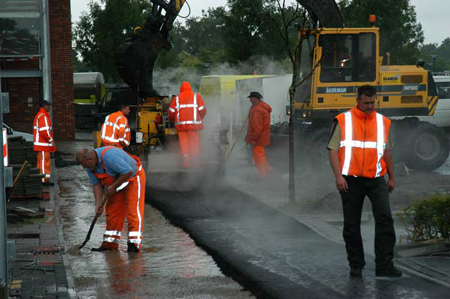
Modern Fossils in asphalt, 2003

modern fossils

Recognisable objects like a wind rose, a mobile phone, a key, a pair of scissors, a safety pin, a ring and also words and poems were rolled into the still hot asphalt of the constructed footpath. They are ‘modern fossils’ that carry the past with them in a playful way. Hester Oerlemans collected these ‘fossils’ together with the residents and personnel of nursing home ‘t Laar and had them placed over the entire stretch of the two hundred meter long footpath, connecting the new and the old part of nursing home ‘t Laar.

modern fossils

Industrial Gardening

August 28th, 2009

Panamarenko
Hofkes, 1967

Panamarenko Hofkens

Three thick sheets of cardboard of about 1m2 are filled with a variety of inorganic trash and debris. From a prophetic kind of future vision Panamarenko nostalgically tries to restore and reconstruct the long lost city-gardens. These city-gardens functioned as urban alternative for life on the countryside and provided additional food for the unfortunate. By the steady increase of city residents (in 2008 a remarkable event took place: the majority of the world population lives now in a city) the necessity to have physical contact with the earth and live from the land is gone. People are used to this new, self-created landscape and recognize the urban environment as their natural habitat.

Peak Oil

August 28th, 2009

Maarten Vanden Eynde
Oil Peak, 2006

Maarten Vanden Eynde Oil Peak

Maarten Vanden Eynde Oil Peak

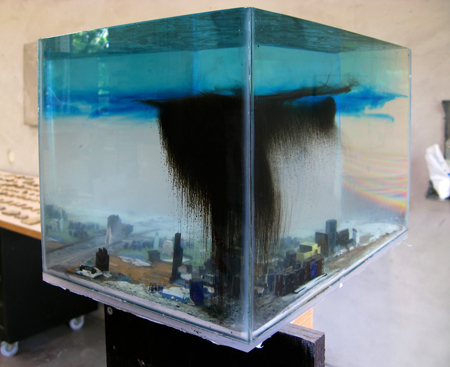
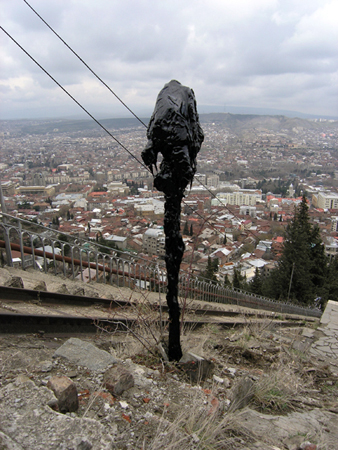
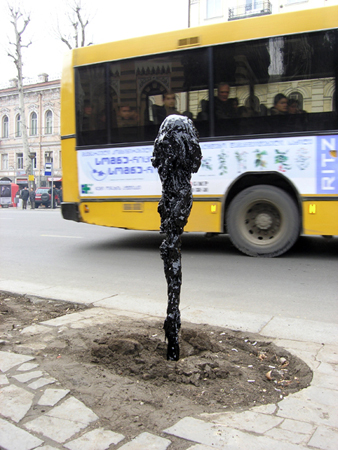
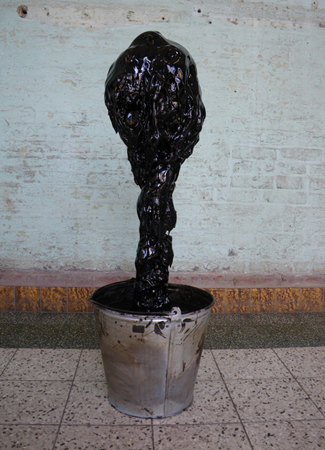
Oil Peak was produced during the third Enough Room for Space (ERforS) project in Tbilisi, Georgia where the most severe protests since the Rose revolution were taking place. In 2003 the new Georgian president Mikheil Saakashvili called back his fellow country men, who fled Georgia in the past decades, to come and help rebuild the once prosperous and wealthy country into a modern western democracy. ERforS decided to respond to this call as well and check out how a new democracy was being introduced or rather implanted and what the side-effects are of such an enormous political and sociological shift. Ten ‘oil eruptions’ were planted on several locations throughout the city. In front of the parliament it caused a surprising commotion as the protesting crowd appropriated the work as a ‘black rose’, symbolizing the failure of the Rose revolution.

Oil Peak, 2008

Maarten Vanden Eynde Oil Peak

Peak oil is the point in time when the maximum rate of global petroleum extraction is reached, after which the rate of production enters terminal decline. The concept is based on the observed production rates of individual oil wells, and the combined production rate of a field of related oil wells. According to Mathew Simmons, author of Twilight in the Desert: The Coming Saudi Oil Shock and the World Economy, “…peaking is one of these fuzzy events that you only know clearly when you see it through a rear view mirror, and by then an alternate resolution is generally too late.” Currently there is no consensus on whether Peak oil occurred already, or is still to come.

The Invisible Line

August 25th, 2009

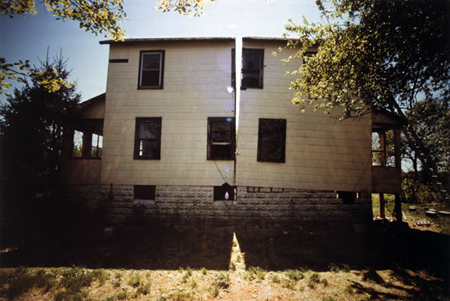
Gordon Matta-Clark
Splitting, 1974

Gordon-Matta-Clark

Gordon Matta-Clark (1943 – 1978) was an American artist best known for his site-specific artworks he made in the 1970s. He is famous for his “building cuts,” a series of works in abandoned buildings in which he variously removed sections of floors, ceilings, and walls. Over a period of about three months in 1974, he made two parallel vertical cuts straight through the middle of a nondescript two-story suburban house in Englewood, New Jersey, removing the material left between the cuts as well as some of the foundation blocks on which the house stood so that one half slightly tilted away from the other, creating a wedge-shaped aperture between them.

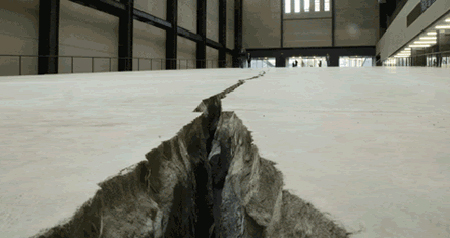
Doris Salcedo
Shibboleth, 2007
doris salcedo

As the very first representative of a non-European tradition to be commissioned by the Tate Modern Unilever Series, Doris Salcedo has chosen an understated technique: that of inscribing into the ground of the Turbine Hall. The scar that begins like a thin, almost invisible line, at the main entrance gradually becomes a chasm in the earth at the far end of the former power station. This earthquake-like insertion evokes the brokenness and separateness of the post-colonial cultures of a non-white, non-European legacy. The installation is a metonymy for the term absence – an absence that negates the space of post-colonial peoples. The construction of a ‘negative space’, or emptied out space, corresponds to the trajectory of the history of post-colonialism. It is in Shibboleth (2007), where space is occupied silently and discreetly, not via a sense of domination or empowerment, that this trajectory can be traced.

An ‘imaginative landscape’ is at work in the heart of what Salcedo states is a monument to a European and modernist tradition of Western art; the Tate Modern. Shibboleth disrupts the Western view of landscape that creates a sense of things being in place and emphasises ‘a visual scape in which the observer stands back and distances himself or herself from the thing observed.’ In reversing the role of the viewer as not only witness but accomplice in an act of silence, Shibboleth proposes a different take on the role of Western art practice and traditions of art: here the earth opens up under the viewers’ feet, evoking an earthquake, an eruption of space, time and place. The view is negated by its downward spiralling motion, bringing to mind a story in Borges’ Labyrinths; negativity has become one with the ground, forcing a glance into an abyss that is disquieting in its silence.

- Abstract from a text by Stella Baraklianou, 2008

doris salcedo

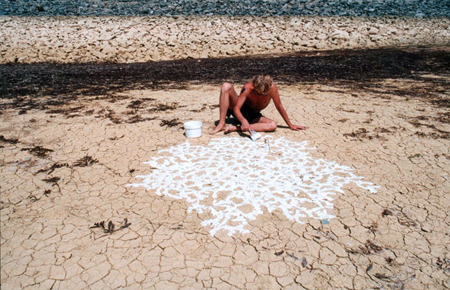
Maarten Vanden Eynde
Restauration du Lac de Montbel, 2003

Maarten Vanden Eynde restauration

Neutral Bunkers

August 22nd, 2009

Leo Fabrizio
Swiss Bunkers, 1999-2004

leo-fabrizio

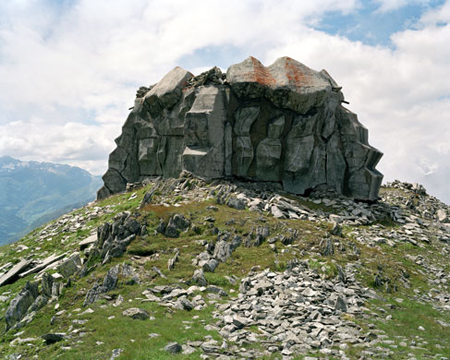
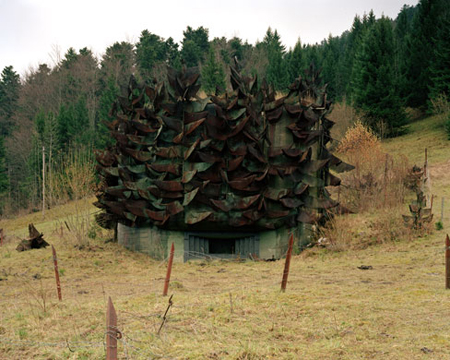
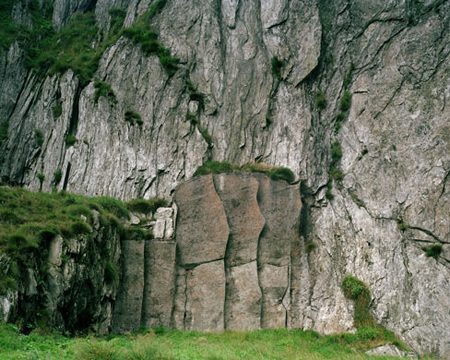
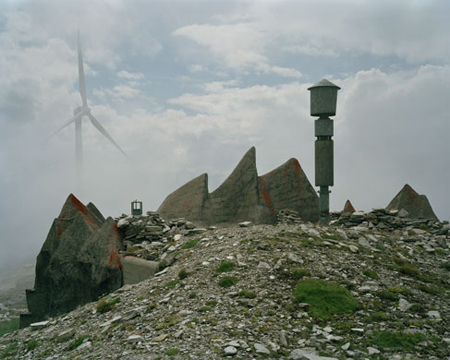
Switzerland is riddled with hidden and disguised military installations. What appeared to be a rock face in a lay-by beside the road were actually steel and concrete doors painted like rock. A five years study by, questioning landscape and identity. Is the territory surrounding us influencing our identity? What happens then when this territory, reputed to be wild and pure, is in fact completely manipulated by humans?

‘After the cold war ended many of the bunkers became obsolete. The tendency is to forget them or even to renounce them, my approach on the contrary, aims to expose them from a new angle. This approach has led me to discover a great number of bunkers, some in remote areas, sometimes difficultly accessible, covering the whole of the Swiss territory. The relations between these basic shaped bunkers and the often-sumptuous landscape surrounds them became an essential part of the study. I looked for the most spectacular bunkers, notable for their camouflage devices, true theatre scenery made with the utmost care. A quality indeed fully Swiss.’ - Leo Fabrizio -

leo-fabrizio

leo-fabrizio

leo-fabrizio

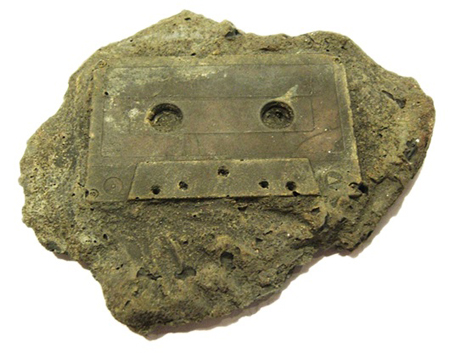
Modern Fossils

July 31st, 2009

Christopher Locke
Modern Fossil -
Asportatio Acroamatis, 2009
(commonly referred to as the Cassette Tape)

fossil-tape

‘These Modern Fossils are made from actual archaic technology that was once cutting-edge. Most of these examples were discovered in the United States, although the various species are represented all over the world. It is sad, but most of these units lived very short lives. Most people attribute the shortened lifespan to aggressive predators or accelerated evolution, but this is not necessarily true. It has been shown recently that the true demise of most of these specimens came from runaway consumerism and wastefulness at the high end of the food chain.

This species was first seen in the mid 1960s, but is not widespread until the 1970s. Similar to Repondecium antiquipotacium, it is thought that the compact disc lead to the decline in the Asportatio acroamatis population in the late 1990s. Asportatio has often been found in close proximity to Ambulephebus sonysymphonia, suggesting a close relationship between the two species’.

- Christopher Locke -

Dominaludus Sexagentaquad, 2009
(commonly referred to as the Nintendo 64 Controller or “N64″)

fossil-nintendo

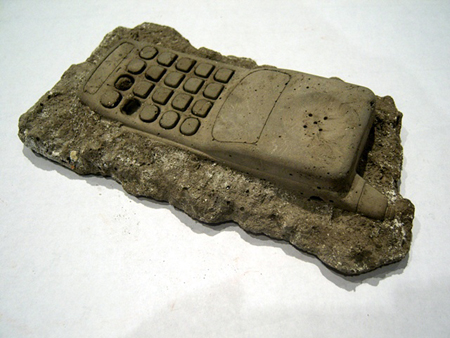
Deferovoculae Cellarius
(commonly referred to as “Cellular Phone” or “Cellphone”. This particular example is a “Motorola Meteor”)

fossil-phone

Digging up the Future: On the Imaginary Archaeology in Art and other Sciences.

May 9th, 2009

[a reaction to Dieter Roelstraete’s  The Way of the Shovel: On the Archeological Imaginary in Art /e-flux journal] by Maarten Vanden Eynde, April 2009

The present returns the past to the future’ – Jorge Luis Borges

Besides prediction models based upon recovered data from the past and the present, there is nothing but imagination at hand to envision the future.

The specific interest or intent of art and all existing sciences seems to flock together whenever a distinctive humanistic evolution is inevitable, creating an épistème of knowledge (1) . In the Middle Ages we struggled to find similarities and resemblances between micro and macro, humans and god, earth and heaven. - We are all alike, mirrored by the image of God - was the prevailing dictum. It took until the 17th century before we started to look for differences, classifying species in separate models (taxonomy, Linnaeus) and paving the way for individual existence. In the 19th century Darwin and Lamarck opened the door to the past and instigated the origin of history.  We discovered where we came from and started to reconstruct the string of our evolution. Marx introduced the theory of historical materialism and added why to the questions of when, where and how. Photography was invented and gave us the first artificial tool to catch a moment. Slowly but destined we became grounded in the reality of the present.
These new certainties, knowing where we come from and the ability to define the distinctiveness of being a homo sapiens sapiens, created an outburst of self-confidence during the 20th century in art and all the other sciences, opening up endless possibilities to act within the present. The result was there, immediately visible and the responsibility was all ours. This conviction in own abilities stimulated the industrial evolution, which changed the world beyond recognition and gave way to the largest population explosion in human history. We learned to genetically manipulate life, we unravelled the mysteries of most DNA strings (including our own), we figured out a way to recreate almost anything out of almost nothing by using nanotechnology, and found ways to be everywhere at the same time (radio, television, internet). We mastered the épistème of the present, leaving but the future to be destined.
The notion of consequence is the first manifestation of futurism; concern slowly replaced the initial euphoria about endless growth and infinite possibilities. The speed of new inventions and subsequently growing knowledge is accelerating just like the expansion of the universe and might bring us to what is currently known as the Singularity (2).  At that moment, predicted to occur around 2035, knowledge is doubled every minute, making it impossible to comprehend for ‘normal’ humans.

Andy Warhol
Campbell’s Soup Cans, 1962

Andy Warhol Campbell soup Andy Warhol Campbell soup

The Club of Rome was the first to use computer models to predict the future (3).  Some predictions proved to be farfetched since evolutions in general behave more chaotic than anticipated, but many future scenarios became reality by now. Their first report Limits of Growth of 1972 caused a permanent interest in what is to come and it is still the best selling environmental book in world history. The second report from 1974 revised the predictions and gave a more optimistic prognosis for the future of the environment, noting that many of the factors were within human control and therefore that environmental and economic catastrophe were preventable or avoidable.
This notion of self-control in relation to making history by interfering in the present became the most important theorem of the 20th century. Also in the art world this feeling of being able to transcendent your own existence by imagining what might, what could and what should became predominant. Although a great deal of artists working with history are digging up old stories, forgotten facts and undisclosed objects of the past to reinvent and reinterpret history, a much bigger number of artists is involved in writing current history, looking at what might be relevant for future generations to remember us by. Preluded by Marcel Duchamp, Andy Warhol was probably the first artist to fully realize the potential of freezing and claiming history by randomly choosing an insignificant object like a can of Campbell soup or a box of Brillo soap and lifting it above oblivion. This self-proclaimed Deus Ex Machina or act of vanguardism was copied by many other artists, like Heim Steinbach, Jeff Koons and Damien Hirst, who, with changing luck, tried through object fetishization to declare or even force history to happen.
A similar strategy is the combination of elements from the past with the present, already cashing the idea that the present is also the future past and that future historians could unwillingly mingle both and by doing so creating a stimulus for an altered state of remembering or stronger; to rewrite history all together. These combined traces of different pasts create an endless chain of possible futures, visualised by artists like Simon Starling, Ai Wei Wei, Wim Delvoye and Brian Jungen.

Ai Wei Wei
Han Dynasty Urn with Coca-Cola Logo
, 1994

Ai Weiwei

To many critics and curators focus on the past to make sense of or give value to archives, artistic research or current art production in general. By doing so, they enforce a self-fulfilling prophecy upon the work and don’t do right to the imagination and sheer curiosity of the creator towards representation of the present in the future. What will remain? What is our heritage for the future? Even artists like Gerard Richter, Roy Arden, Peter Pillar, Batia Suter and Lois Jacobs who on a first glimps seem to work with the past are rather formulating different answers to what could or should remain of the present.
Roy Arden’s Versace for instance is not looking at the past in the historical sense but merely imagining how we might look back at the past in the future. It questions the relevance or value of anything present in our contemporary society to represent that same society in the future. Many other artists like Cornelia Parker, Mark Dion, Damien Hirst and Guillaume Bijl are doing the same thing; they lay the foundation of future history. They are telling a story, our story. Cornelia Parker uses remnants of (self) destroyed parts of reality and tries to put it back together again. Mark Dion is showing the left over’s of our society in a more ‘classic’ archaeological context and Damien Hirst and Guillaume Bijl subtract a certain object or entire space out of our present world, like a slice of cake, and preserve it directly for future generations. Although using different modes of working they all work with possible remnants of our current civilisation, imagining different pieces of the puzzle that could be used in the future to puzzle back together again the history we are currently creating. They work within the future, not the past.

Roy Arden
Versace, 2006

Roy Arden Versace

This interest, or calling upon, is visible not only in the current art world but across most branches of the science tree. In the field of Biology animals are duplicated, cloned, crossbred and pimped in all imaginable ways to become stronger, smaller, longer lasting, fluorescent (4), faster running,… in general better equipped for eternity. Humans haven’t only discovered how to eradicate life, destroying, willingly or not, several entire species and ecosystems in the past, by now we also know how to manipulate and maintain life. The promise of being able to cure almost any disease in the near future by using nanobots to do the dirty work, caused a real run for life extension programs like Alcor, the world leader in Cryonics (5). More than one hundred people have been cryopreserved since the first case in 1967. More than one thousand people have made legal and financial arrangements for cryonics with one of several organizations, usually by means of affordable life insurance. The majority chose to only preserve their head, assuming that the body could be regenerated very easily in the future, using the same technique as lizards do to grow back a limb.
The current emphasis on preservation seems also in Archaeology, a science that is traditionally grounded in the past, to overrule the act of excavation. Prophesising on an eminent crisis or apocalyptic disaster inspired us to bury time capsules deep underground containing samples of current societies including their historical highlights. In 2008 the Svalbard Global Seed Vault opened its doors for all the 1,300 gene banks throughout the world. The Seed Vault functions like a safety deposit box in a bank. The Government of Norway owns the facility and the depositing gene banks own the seeds they send. The vault now contains over 20 million seeds, samples from one-third of the world’s most important food crop varieties. In 1974 Ant Farm constructed Cadillac Ranch, ten Cadillac’s, ranging from a 1949 Club Coupe to a 1963 Sedan, buried fin-up in a wheat field in Texas. Much later, in 2006, during a performance work called Burial, Paul McCarthy and Raivo Puusemp buried one of McCarty’s own sculptures in the garden of Naturalis, the National History Museum of Leiden in The Netherlands. The buried sculpture resides underground as an artefact for future discovery.

Ant Farm
Cadillac Ranch, 1974

Ant Farm

Ant Farm

Currently, four time capsules are “buried” in space. The two Pioneer Plaques and the two Voyager Golden Records have been attached to a spacecraft for the possible benefit of space farers in the distant future. A fifth time capsule, the KEO satellite, will be launched around 2010, carrying individual messages from Earth’s inhabitants addressed to earthlings around the year 52,000, when KEO will return to Earth (6). In Cosmology as well the focus is on the future. Experiments are conducted to create black holes, possible portals to travel through time. Terraforming attempts might create an atmosphere around a distant planet or moon creating a possible escape for human kind if planet earth is not viable anymore.
In 1971 the first artwork was placed on the moon. Fallen Astronaut, created by Belgian artist Paul Van Hoeydonck, is an aluminium sculpture of 8,5 cm representing a sexless abstraction of a human. It was left on the moon by the Apollo 15 crew next to a memorial plaque stating all the names of astronauts that died on their way to the moon. In 2003 a work of art by Damien Hirst consisting of 16 multi-coloured spots on a 5cm by 5cm aluminium plate was send to Mars. The colours would be used to adjust the camera while a special composed song of the British pop-band Blur would be played to check the sound and accompany the arrival of the Mars Lander, the Beagle 2. The sequel of Darwin’s exploration vessel was last seen heading for the red planet after separating from its European Space Agency mother ship Mars Express on December 19 2003. Part of a mission estimated to cost $85 million, the probe was supposed to land on Mars a few days later on Christmas Day and search for signs of life, but vanished without trace…

Damien Hirst Beagle2

Closer to earth itself many artists have made works that can be seen from outer space. The biggest one, Reflections from Earth is made by Tom Van Sant in 1980: a series of mirrors over a 1.5 mile stretch of the Mojave Desert in the shape of an eye. In 1989 Pierre Comte did something similar with Signature Terre: sixteen squares of black plastic fabric with sides measuring 60m creating the “Planet Earth” symbol. Two noble attempts to leave a trace and write history but as a work of art not surpassing the early Land Art by Robert Smithson (Asphalt Rundown, 1969 and Spiral Jetty, 1970) or even smaller interventions by Richard Long (A line made by walking, 1967) or Christo and Jeanne-Claude’s Surrounded Islands of 1980-83. No single work of art however can compete with the collaborative global effort to create a new geological layer over the earth, consisting of asphalt, concrete and plastic, contemporary materials representing our current civilisation. No matter what happens, we will all be remembered, that is for sure. We just don’t know how. ‘Will we arrive at a moment of sufficient self-alienation where we can contemplate on our own destruction as in a static spectacle’? (7). I don’t think so. We will be to busy with self-preservation, looking back to figure out what lays ahead. Like the speakers of Aymara, an Indian language of the high Andes, who think of time differently than just about everyone else in the world, we should also position the future behind us, because you can not see it and the past ahead of us, since that is the only thing we can see. This is precisely what so many artists are doing today; looking backwards to discover the future. Whatever lies in front of you and can be seen is used as inspiration source to imagine the unknown.

(1) Michel Foucault used the term épistème in his work The Order of Things (Les Mots et les choses. Une archéologie des sciences humaines, 1966) to mean the historical a priori that grounds knowledge and its discourses and thus represents the condition of their possibility within a particular epoch.
‘I would define the episteme retrospectively as the strategic apparatus which permits of separating out from among all the statements which are possible those that will be acceptable within, I won’t say a scientific theory, but a field of scientificity, and which it is possible to say are true or false. The episteme is the ‘apparatus’ which makes possible the separation, not of the true from the false, but of what may from what may not be characterised as scientific’.
(2) Ray Kurzweil, The Law of Accelerating Returns, 2001
An analysis of the history of technology shows that technological change is exponential, contrary to the common-sense ‘intuitive linear’ view. So we won’t experience 100 years of progress in the 21st century—it will be more like 20,000 years of progress (at today’s rate). The ‘returns,’ such as chip speed and cost-effectiveness, also increase exponentially. There’s even exponential growth in the rate of exponential growth. Within a few decades, machine intelligence will surpass human intelligence, leading to the Singularity—technological change so rapid and profound it represents a rupture in the fabric of human history. The implications include the merger of biological and nonbiological intelligence, immortal software-based humans, and ultra-high levels of intelligence that expand outward in the universe at the speed of light.
(3) The Club of Rome is a global think tank that deals with a variety of international political issues. It was founded in April 1968 and raised considerable public attention in 1972 with its report Limits to Growth. In 1993, it published followup called The First Global Revolution. According to this book, “It would seem that humans need a common motivation, namely a common adversary, to organize and act together in the vacuum; such a motivation must be found to bring the divided nations together to face an outside enemy, either a real one or else one invented for the purpose….The common enemy of humanity is man….democracy is no longer well suited for the tasks ahead.”, and “In searching for a new enemy to unite us we came up with the idea that pollution, the threat of global warming, water shortages, famine and the like, would fit the bill.” This statement makes it clear that the current common adversary is the future itself.
(4) Alba, the first green fluorescent bunny made by artist Eduardo Kac in 2000, is an albino rabbit. This means that, since she has no skin pigment, under ordinary environmental conditions she is completely white with pink eyes. Alba is not green all the time. She only glows when illuminated with the correct light. When (and only when) illuminated with blue light (maximum excitation at 488 nm), she glows with a bright green light (maximum emission at 509 nm). She was created with EGFP, an enhanced version (i.e., a synthetic mutation) of the original wild-type green fluorescent gene found in the jellyfish Aequorea Victoria. EGFP gives about two orders of magnitude greater fluorescence in mammalian cells (including human cells) than the original jellyfish gene.
(5) Cryonics is the speculative practice of using cold to preserve the life of a person who can no longer be supported by ordinary medicine. The goal is to carry the person forward through time, for however many decades or centuries might be necessary, until the preservation process can be reversed, and the person restored to full health. While cryonics sounds like science fiction, there is a basis for it in real science. (www.alcor.org)
(6) ‘KEO, The satellite that carries the hopes of the world. What reflections, what revelations do your future great grandchildren evoke in you? What would you wish to tell them about your life, your expectations, your doubts, your desires, your values, your emotions, your dreams’? (www.keo.org)
(7) Walter Benjamin (Technocalyps – Frank Theys, 2006)

The Way of the Shovel: On the Archeological Imaginary in Art

May 7th, 2009

By Dieter Roelstraete

He who seeks to approach his own buried past must conduct himself like a man digging.

—Walter Benjamin1

[Preliminary admonition: there is no disgrace in seeking to define either the essence or the attributes of art. For…]

…art is, or at least can be, many things at many different points in time and space. Throughout its history—which is either long or short, depending on the definition agreed upon—it has assumed many different roles and been called upon to defend an equal number of different causes. Or, alternately—and this has turned out to be a much more appealing and rewarding tactic for most of the past century—it has been called upon to attack, question, and criticize any number of states of affairs. In the messianic sense of a “calling” or κλησις—a call to either change or preserve, for those are the only real options open to the messianic—we might locate both the roots of art’s historical contribution to the hallowed tradition of critique and the practice of critical thought, as well as its share in the business of shaping the future—preferably (and presumably) a different future from the one that we knowingly envision from the vantage point of ”today.”

In the present moment, however, it appears that a number of artists seek to define art first and foremost in the thickness of its relationship to history. More and more frequently, art finds itself looking back, both at its own past (a very popular approach right now, as well as big business), and at “the” past in general. A steadily growing number of contemporary art practices engage not only in storytelling, but more specifically in history-telling. The retrospective, historiographic mode—a methodological complex that includes the historical account, the archive, the document, the act of excavating and unearthing, the memorial, the art of reconstruction and reenactment, the testimony—has become both the mandate (“content”) and the tone (“form”) favored by a growing number of artists (as well as critics and curators) of varying ages and backgrounds.2 They either make artworks that want to remember, or at least to turn back the tide of forgetfulness, or they make art about remembering and forgetting: we can call this the “meta-historical mode,” an important aspect of much artwork that assumes a curatorial character. With the quasi-romantic idea of history’s presumed remoteness (or its darkness) invariably quite crucial to the investigative undertaking at hand, these artists delve into archives and historical collections of all stripes (this is where the magical formula of “artistic research” makes its appearance) and plunge into the abysmal darkness of history’s most remote corners. They reenact—yet another mode of historicizing and storytelling much favored by artists growing up in a culture of accelerated oblivion—reconstruct, and recover. Happy to honor their calling, these artists seek out the facts and fictions of the past that have mostly been glossed over in the more official channels of historiography, such as the “History Channel” itself.3 They invariably side with both the downtrodden and the forgotten, reveal traces long feared gone, revive technologies long thought (or actually rendered) obsolete, bring the unjustly killed back to (some form of) life, and generally seek to restore justice to anyone or anything that has fallen prey to the blinding forward march of History with a capital, monolithic “H”—that most evil of variations on the Hegelian master narrative.


Jeff Wall, Fieldwork. Excavation of the floor of a dwelling in the former Sto:lo nation village, Greenwood Island, Hope, B.C., August, 2003, Anthony Graesch, Dept. of Anthropology, University of California at Los Angeles, working with Riley Lewis of the Sto:lo band, 2003. Transparency in lightbox, 219.5 x 283.5 cm.
Collection of the artist. Courtesy Marian Goodman Gallery, New York.

The reasons for this oftentimes melancholy (and potentially reactionary) retreat into the retrospective mode of historiography are manifold, and are of course closely related to the current crisis of history both as an intellectual discipline and as an academic field of enquiry. After all, art’s obsession with the past, however recently lived, effectively closes it off from other, possibly more pressing obligations, namely that of imagining the future, of imagining the world otherwise (“differently”). Our culture’s quasi-pathological systemic infatuation with both the New and the Now (“youth”) has effectively made forgetting and forgetfulness into one of the central features of our contemporary condition, and the teaching of history in schools around the globalized world has suffered accordingly.

[This diagnosis of a “crisis of history” may strike the informed reader as unnecessarily alarmist and overblown: indeed, even the most cursory glance at the groaning bookshelves in the “History” section of one’s local culture mall—or its counterpart on Amazon.com—seems to suggest the opposite to be true. True, there is plenty of historiography out there, but it is of a very problematic, myopic kind that seems to add to the cultural pathology of forgetting rather than fight against it. It is a type of writing that prefers to hone in on objects (the smaller, the more mundane, and the less significant, the better) rather than people, the grand societal structures that harness them, or the events that befall them and/or help bring those structures into being. Virtually every little “thing” has become the subject of its own (strictly “cultural”) history of late, from the pencil to the zipper, the cod, the porcelain toilet bowl, the stiletto, the potato, or the bowler hat. It does not require too great an imaginative effort to discern the miserable political implications of this obsession with detail, novelty, and the quaint exoticism of the everyday (best summed up by the dubious dictum “small is beautiful”). Indeed, it seems sufficiently clear that the relative success story of this myopic micro-historiography, with its programmatic suspicion of all forms of grand historicization, is related both to today’s general state of post-ideological fatigue as well as to the political evacuation (or de-politicization) of academia, of which the “crisis of history” is precisely such an alarming, potent symptom.]


Roy Arden, Versace, 2006.
Archival pigment print, 25 x 21 inches.

In this sense, art has doubtlessly come to the rescue, if not of history itself, then surely of its telling: it is there to “remember” when all else urges us to “forget” and simply look forward—primarily to new products and consumerist fantasies—or, worse still, inward. Indeed, this new mode of discursive art production boasts an imposing critical pedigree, a long history of resistance and refusal: the eminent hallmarks, as we know, of true vanguardism.

One geopolitical region whose recent (and rewardingly traumatic) history has become especially prominent with art’s turn towards history-telling and historicizing (its turn away from both the present and the future), is post-communist Central and Eastern Europe—the preferred archeological digging site (if only metaphorically) of many well-read artists whose work has come of age in the broader context of the globalized art market of the last decade and a half. Ironically enough, the region’s triumph was wholly determined by the demise of the system of state socialism that so many of us now seek to memorialize.

[It is perhaps unnecessary to add here that the majority of these amateur archeologists hail from the “West,” where there may still exist certain pockets of nostalgia for the ideological clarity, among other things, of the Cold War era, when Central and Eastern Europe could be imagined as something radically “different,” belonging to “another” political world entirely—hence also its quasi-inexhaustible appeal to critical art: art that is committed to “making a difference.” Obviously, a similar type of nostalgia is also felt by a younger generation of artists from the former Eastern Bloc—but differently so, and the generational shift is of crucial importance here.4]

In their cultivation of the retrospective and/or historiographic mode, many contemporary art practices inevitably also seek to secure the blessing (in disguise) of History proper: in an art world that seems wholly dominated by the inflationary valuations of the market and its corollary, the fashion industry (“here today, gone tomorrow,” or, “that’s so 2008”), time, literally rendered as the subject of the art in question, easily proves to be a much more trustworthy arbiter of quality than mere taste or success. Hence the pervasive interest of so many younger artists and curators in the very notion of anachronism or obsolescence and related “technologies of time”: think of Super 8 mm and 16 mm film, think of the Kodak slide carousel, think of antiquated, museum-of-natural-history-style vitrines meant to convey a sense of the naturalization of history, or of time proper. Perhaps many artists use these tried-and-tested methods of history as a science, or as a mere material force (the archival mode ranks foremost among these methods), in hopes that some of its aristocratic sheen will rub off on their own products or projects, or otherwise inscribe them and their work in the great book of post-History . . .


Goshka Macuga, When Was Modernism, 2008.
Mixed media, installation at Museum voor Hedendaagse Kunst Antwerpen (MuHKA).
Courtesy the artist, Kate MacGarry and MuHKA

One of the ways in which this historiographic “turn” has manifested itself lately is though a literalized amateur archeology of the recent past: digging. Archeology’s way of the shovel has long been a powerful metaphor for the various endeavors that both spring from the human mind and seek to map the depths of, among other things, itself. Perhaps the most famous example of this would be psychoanalysis (or “depth psychology”), in which the object of its archaeological scrutiny is the human mind. Throughout a history that stretches far beyond the work of, say, Robert Smithson, Haim Steinbach, or Mark Dion, psychoanalysis has long been a source of fascination and inspiration for the arts. Certainly, one could conceive of an exhibition consisting solely of artistic images of excavation sites, of “art about archeology.” The truth claims of art often quote rather literally and liberally from the lingua franca of archeology: artists often refer to their work as a labor of meticulous “excavation,” unearthing buried treasures and revealing the ravages of time in the process; works of art are construed as shards, fragments (the Benjaminian ciphers of a revelatory truth), traces preserved in sediments of fossilized meaning. Depth delivers artistic truth: that which we dig up (the past) in some way or other must be more “real” and therefore also more “true” than all that has come to accumulate afterwards to form the present. This also says something about why we think the present is so hard to explain.

Likewise, the scrupulous archeological ethic of unending patience and monastic devotion to detail—seamlessly mirrored in its preferred optic, that of the clinical close-up—is, in spirit, close to the obsessive labor or “science” of art-making that often requires plodding through hours, days, and weeks of menial rubble-and-manure-shoveling before something that may (or may not) resemble a work of art emerges. Michelangelo’s sculptures of dying slaves wresting themselves free from the marble in which the artist “found” them captive continue to provide what is perhaps the archeological paradigm’s most gripping image.5 Furthermore, there can also be no archeology without display—the modern culture of museum display (if not of the museum itself) is as much “produced” by the archeologist’s desire to exhibit his or her findings as it is by the artist’s confused desire to communicate his or hers. After all, the logical conclusion of all excavatory activity is the encasing of History’s earthen testimony within a beautiful, exquisitely lit, amply labeled glass box—an apt description, indeed, of much artistic and meta-artistic or curatorial activity of the last decade and a half.6 Finally (and most importantly, perhaps), art and archeology also share a profound understanding—and one might say that they are on account of this almost “naturally” inclined to a Marxist epistemology—of the primacy of the material in all culture, the overwhelming importance of mere “matter” and “stuff” in any attempt to grasp and truly read the cluttered fabric of the world. The archaeologist’s commitment is to earth and dirt, hoping that it will one day yield the truth of historical time; the artist’s commitment is to the crude facts of his or her working material (no matter how “virtual” or, indeed, immaterial this may be), which is equally resistant to one-dimensional signification and making-sense, equally prone to entropy—yet likewise implicated in a logic of truth-production.


Mark Dion, The Birds of Antwerp, 1993.
Mixed media, installation at Museum voor Hedendaagse Kunst Antwerpen (MuHKA).

In this critical Bataillean sense of a “base materialism”—a materialism from which all traces of formalist idealization have been evacuated—both art and archeology are also work—hard and dirty work, certain to remind us of our bodily involvement in the world. The archeological imaginary in art produces not so much an optics as it does a haptics—it invites us, forces us to intently scratch the surface (of the earth, of time, of the world) rather than merely marvel at it in dandified detachment. By thus intensifying our bodily bondage to a world that, like our bodies themselves, is made up first and foremost of matter, the alignment of art and archeology compensates for the one tragic flaw that clearly cripples the purported critical claims and impact of the current “historiographic turn” in art: its inability to grasp or even look at the present, much less to excavate the future.

e-flux journal #4

1 Walter Benjamin, “Excavation and Memory,” in Selected Writings, Volume 2, Part 2, 1931–1934, ed. Michael W. Jennings, Howard Eiland, and Gary Smith, trans. Rodney Livingstone et al. (Cambridge, MA: The Belknap Press of Harvard University Press, 1999), 576. Benjamin continues: “Above all, he must not be afraid to return again and again to the same matter; to scatter it as one scatters earth, to turn it over as one turns over soil. For the “matter itself” is no more than the strata which yield their long-sought secrets only to the most meticulous investigation. That is to say, they yield those images that, severed from all earlier associations, reside as treasures in the sober rooms of our later insights.” In the words of Peter Osborne, “Benjamin’s prose breeds commentary like vaccine in a lab,” Radical Philosophy, no. 88 (1998), .

2 Mark Godfrey’s much-discussed essay “The Artist as Historian,” published in October 120 (2007), has become a local landmark of sorts. In it Godfrey states that “historical research and representation appear central to contemporary art. There are an increasing number of artists whose practice starts with research in archives, and others who deploy what has been termed an archival form of research” (142–143). He then goes on to focus on the work of one artist-as-historian in particular, Matthew Buckingham, forgoing the opportunity to offer the reader an explanation, no matter how speculative or tentative, as to why historical research and representation in general have become so central to contemporary art (again). Furthermore, as the work of a historian does not necessarily coincide with that of a historiographer, the job description that I would suggest is more accurate with regard to contemporary art practice: the act of “writing” (or, more broadly, narrating) adds a key distinction here.

3 This analogy prompts the memory of a similar televisual metaphor: when asked about the socio-political import of hip-hop, Public Enemy’s charismatic frontman Chuck D famously called the genre “the CNN of Black America,” in that it also provides its (supposedly marginalized) constituency with informal, unofficial history lessons and alternative views of mainstream “news”—or any fact of world history that may have fallen by the wayside in a process of ideological homogenization. Likewise, it has sometimes been said that many of the last decade’s most important mega-exhibitions (biennials, documentas, Manifestas—not art fairs) at times came to resemble documentary film festivals where the likes of Discovery Channel, the History Channel and the National Geographic Channel come to exchange their wares, making the art world look like something akin to a BBC World program of politically disenchanted aesthetes and TV-hating intellectuals.

4 The historiographic turn in “post-socialist” European art specifically is the subject, among other things, of Charity Scribner’s aptly titled Requiem for Communism, published by MIT in 2003. An exhaustive list of practitioners from post-socialist “Eastern” Europe who self-reflexively mine this particular field would be hard to compile; however, such a list would definitely have to include the names of Chto Delat, Aneta Grzeszykowska, Marysa Lewandowska & Chris Cummings, Goshka Macuga, David Maljković, Deimantas Narkevicius, Paulina Olowska, and to a certain extent also Anri Sala and Nedko Solakov. Artists from the “West” who have consistently devoted their attention to the intricate meshwork of some of these histories include Gerard Byrne, Tacita Dean, Laura Horelli, Joachim Koester, Susanne Kriemann, Sophie Nys, Hito Steyerl, Luc Tuymans, and many more.

5 Michelangelo’s statement with regard to the slave figures, that he was “liberating them from imprisonment in the marble,” also recalls the famous motto that guided his near-contemporary Albrecht Dürer: “Truly art is firmly fixed in Nature. He who can extract her thence, he alone has her.” We could easily replace Dürer’s idealized, quasi-divine Nature in this last quote with Culture, History, or Time in order to paint a fairly accurate picture of the thinking that goes on behind (or, better still, underneath) much historiographic-art production today: this strand of contemporary art is as much a business of extraction as it is one of excavation.

6 A great many artists have been “mining the museum” in recent years, and their interest in museological displays and genealogical frameworks certainly belongs to the broader thrust of the historiographic turn in contemporary art: Fred Wilson coined the geological formula, Louise Lawler and Mark Dion did some exploratory groundwork (quite literally, in the latter’s case), while Carol Bove, Goshka Macuga, Josephine Meckseper, Jean-Luc Moulène and Christopher Williams rank among the micro-genre’s better-known contemporary practitioners. Many of the artists working in this field of a critical museology have a complicated relationship with the habitus of institutional critique, to which it is obviously indebted; they certainly “long for” the museum much more strongly and directly than the first generation of institutional critics would ever allow themselves to. In the speleological imaginary of “mining the museum”—note the sexual undertones of this metaphor—the museum has become an object of desire as much as an object of critique, a cavity as much as an excavation site.

Present the Present

May 4th, 2009

‘Are you present in the present to present the present?’ - Jamila Adeli, artistic director of BodhiBerlin asking independant curator Manray Hsu during a dialogue called: Can The Same Exhibition Happen Everywhere? in the framework of Rotterdam Dialogues: The Curators, March 7th 2009, Witte de With, Rotterdam, The Netherlands.

Félix Gonzàlez-Torres
Untitled (Perfect Lovers), 1991

Felix Gonzales Torres

Concrete Casting

February 6th, 2009

Rachel Whiteread
House, 1993
concrete,  (destroyed)

Rachel Whiteread House

House, perhaps Whitereads best known work, was a concrete cast of the inside of an entire Victorian terraced house completed in autumn 1993, exhibited at the location of the original house — 193 Grove Road — in East London (all the houses in the street had earlier been knocked down by the council). It drew mixed responses, winning her both the Turner Prize for best young British artist in 1993 and the K Foundation art award for worst British artist.

Rachel Whiteread House

Nineteenth-century sculptors referred to the process of bronze casting as life, death, and resurrection as the original live object was destroyed in the casting process and resurrected in bronze. In a similar but distinctly different manner Rachel Whiteread casts the space inside, around, and adjacent to objects that have been part of people’s lives. This process and her choice of materials transform the residue of everyday life into ghostlike, uncanny spirit images of everyday objects.

Rather than using the traditional casting process of making molds of objects and then casting them in a different material, Whiteread uses the objects themselves as molds. For example her 2002 sculpture “Sequel IV”, is a casting of the enclosing space surrounding the backs of a library shelf done in plaster. This is a reversal of a bookshelf as the titles are hidden and the books inaccessible. Instead of inviting browsing, these books are inaccessible shadows, frozen in time, reflecting hidden knowledge. It is as if we came upon an ancient ruin of a library.

Sequel IV, 2002

Rachel Whiteread Sequel

Text by Damon Hyldreth


The Dogs From Pompei

February 6th, 2009

Allan McCollum
The Dog From Pompei, 1991
Cast glass-fiber- reinforced Hydrocal

Allan McCollum pompei dog

Mount Vesuvius was blazing in several places…A black and dreadful cloud bursting out in gusts of igneous serpentine vapor now and again yawned open to reveal long, fantastic flames, resembling flashes of lightning, but much larger…Cinders fell…then pumice-stones too, with stones blackened, scorched, and cracked by fire …

The scene described by Pliny the Younger occurred on an August afternoon in 79 A.D. Of the more than 20,000 inhabitants in the city of Pompei, several hundred died that day in their homes and in the streets. The rest fled toward the sea.

The cavity of The Dog From Pompei was discovered November 20, 1874, in the house of Marcus Vesonius Primus, in the “Fauce,” the corridor at the entrance of the house. The house was located in Region VI, Insula 14, Nr. 20.
During the eruption, the unfortunate dog, wearing his bronze-studded collar, was left chained up at his assigned place to watch the house, and he suffocated beneath the ash and cinders.
Allan McCollum’s casts were taken directly from a mold made especially for the artist from the original second-generation cast presently on display at the Museo Vesuviano, in present-day Pompei.

Allan McCollum pompei dog

Lost Objects, 1991

Allan McCollum lost objects

The Natural Copies from the Coal Mines of Central Utah, 1993.

Allan McCollum natural copies

Allan McCollum’s series The Natural Copies from the Coal Mines of Central Utah is a companion to the two series’ he’d done before—the Lost Objects (casts of dinosaur bones) and The Dog From Pompei— all created from gypsum casts of fossils and done in cooperation with natural history museums around the world. The Natural Copies are recastings of “natural casts” of dinosaur tracks found in the roofs of coal mines in central Utah, which are produced through a process of natural fossilization as follows:
(a) by dinosaurs walking over spongy beds of decaying vegetation (peat); (b) by the footprints being filled with sand, (c) by the accumulation of thousands of feet of additional sediment, which compressed the peat to help form coal and solidified the sand to sandstone; (d) by removal of the coal in mining operations so as to leave the tracks protruding downward into the mine; and finally, (e) by the geologist brushing away the residue of coal to expose the sandstone filling the original track.

McCollum offers his Natural Copies as an allegorical presentation of the narrative attached to other kinds of collectibles and fine art objects: in their various modes of production, exhibition, distribution, and collection; their use and exchange value; their function as markers of natural history or embodiments of cultural memory; their ambiguous status as found objects, cultural artifacts, scientific specimens or fine art objects; and their relation to local lore and folk stories of the region.

By reproducing the natural casts as artworks, McCollum intersects another narrative into the story. Originally discovered in the roofs of underground mines, the footprints’ inverted position offers the eerie experience of a dinosaur walking on the ground above one’s head, already suggesting the realm of the fantastic: monsters and exotic creatures from a primeval and forgotten past, treasures produced over the millennia and unearthed from the subterranean depths through the competative and determined search for “the rock that burns.” McCollum’s evocation of this narrative in the fine art context immediately transforms it into a metaphor for romantic views of the archaic and unconscious sources of human creativity, and at the same time suggests a symbolic shadow narrative that might underlie all social relations in communal labor.

Integral to his exhibitions is the accompanying display of multicolored photocopies of didactic literature the artist calls the Reprints. This other display of “copies” reiterates the metaphorical references to community organization, production, and dissemination in the real time of the exhibition space itself; it not only suggests an alternative to the convention of the expensive fine art catalogue, it simultaneously presents an exuberant, allegorical drama of repetition and production which imagines an uncanny continuity between the geological (natural) copying of tracks and traces from a prehistoric past and the mechanical and electronic endless copying of today.

Apologetic Archaeology

February 4th, 2009

Guillaume Bijl
Archaeological Site (A Sorry Installation), 2007

Guillaume Bijl

Right in the middle of a grassy area on the Sentruper Höhe by Lake Aa with nothing but trees and meadows around, is a milestone of cultural tourism. If the spectator steps a bit closer, he can view the archaeological excavation site from a balustrade guarding the edge of the pit. Standing there, he will see an unearthed, shingle-roofed spire topped by a weathercock. Guillaume Bijl discovered it – or rather, he invented it, as the spectator will quickly have guessed. It is an absurd, surrealist sculpture. With their steeples, the churches of Münster are still an integral part of the urban landscape. Bijl came up with the idea that “somebody could discover another church – one that had fallen victim to the passage of time, buried during the war.” And, thanks to the Belgian artist, Münster has now gained new perspective on the culture of façades.
With his characteristic charm, Guillaume Bijl has added an apologetic gesture to his work, assigning it to the category of “sorry objects” that reveal themselves to be reproductions. However, Bijl is not apologizing for drawing a caricature of our expectations, but rather for betraying his normal emphasis on realism. His modesty will probably not help him much, though, for his steeple will become a tourist attraction.

Guillaume Bijl

The car-age

February 3rd, 2009

Patrick Nagatani
Bentley, Stonehenge, Salisbury Plain, Wiltshire, England, 1987

Patrick Nagatani

Nagatani informs us that in 1985, a Japanese archeologist named Ryoichi received a mysterious set of maps that led him to excavate numerous historic and contemporary sites around the world noted for their cultural significance. For fifteen years Ryoichi and his team secretly excavated Stonehenge, Chaco Canyon, Ayers Rock, Kitt Peak National Observatory, the very Large Array radio-telescope, and other sites. At each location they unearthed a different make of car. Buried in the volcanic ash at Herculaneum they found a Ferrari. In the foundations of the Observatory at Chichen Itza was a Jaguar, while a Bentley emerged from Salisbury Plain near Stonehenge. Ryoichi had discovered a worldwide “automobile culture” that appeared to parallel our own, although it was anachronistic both historically and geographically. After unearthing the artifacts, Ryoichi’s team covered up all evidence of their digs, but not before Nagatani had photographed each site, providing the only existing record of Ryoichi’s discoveries.

Excavations: Recent Photographs by Patrick Nagatani
Andrew Smith Gallery, Santa Fe, US, 2001

Model A Woody, National Astronomy Observatory (VLA), NM, USA, 1997

Patrick Nagatani

Volkswagon ‘Beetles’, Xi’an, Necropolis of Mt. Li’, China, 1988

Patrick Nagatani

Time as a Vertical Dimension

January 18th, 2009

Walter De Maria
Vertical Earth Kilometer, 1977

Walter De Maria Vertical Earth Kilometer

A km-long rod of metal was buried vertically in the ground. The boring of the shaft, which goes through six geological layers, took seventy-nine days. The continuous metal rod is made of 167 m-long rods, screwed tightly together. The sandstone square which surrounds the top of the shaft is at the intersection of two paths which traverse the Friedrichsplatz in Kassel, Germany, site of theinternational contemporary art serveys, Documenta. The work is only visible in section: the kilometer of metalplunged into the earth can be seen as a representation of time in a vertical dimension.

- from 'Land and Environmental Art' by Jeffrey Kastner and Brian Wallis, PHAIDON -

Walter De Maria
The Broken Kilometer, 1979

Walter De Maria The Broken Kilometer
Courtesy Dia Art Foundation © the artist. Photo: John Abbott
500 brass rods, permanently installed at 393 West Broadway, New York City
Each rod 200x5cm

With The Broken Kilometer, De Maria had put in place the fourth and last stage of his multi-part sculptural system. While the solid brass work in Kassel plunged a kilometre into the ground and The Lightning Field in New Mexico marked out an area of one kilometre by one mile with poles that all reached the same, absolute height, in 1977 he created The New York Earth Room – apparently permanently – by covering the entire floor of a room in Friedrich’s other SoHo gallery with an even layer of earth. The work can still be seen on the second floor at 141 Wooster Street. Two years later, when The Broken Kilometer – filling the whole floor space of a gallery – was installed as a permanent exhibition, it was clear that the viewer who encountered the piece in astonishment could only respond in one way: silent contemplation. - Thomas Kellein director Kunsthalle Bielefeld.

Landscaping

January 6th, 2009

Edward Burtynsky
Kennecott Copper Mine No. 22, Bingham Valley, Utah,
1983

Edward Burtynsky

‘Nature transformed through industry is a predominant theme in my work. I set course to intersect with a contemporary view of the great ages of man; from stone, to minerals, oil, transportation, silicon, and so on. To make these ideas visible I search for subjects that are rich in detail and scale yet open in their meaning. Recycling yards, mine tailings, quarries and refineries are all places that are outside of our normal experience, yet we partake of their output on a daily basis’. - Edward Burtynsky -

Tanggu Port, Tianjin, 2005

Edward Burtynsky

‘These images are meant as metaphors to the dilemma of our modern existence; they search for a dialogue between attraction and repulsion, seduction and fear. We are drawn by desire - a chance at good living, yet we are consciously or unconsciously aware that the world is suffering for our success. Our dependence on nature to provide the materials for our consumption and our concern for the health of our planet sets us into an uneasy contradiction. For me, these images function as reflecting pools of our times’.
- Edward Burtynsky -

Oxford Tire Pile No. 5, Westley, CA, 1999

Edward Burtynsky

Oil Fields No. 13, Taft, California, 2002

Edward Burtynsky

Urban Renewal #5, City Overview From Top of Military Hospital, Shanghai, 2004

Edward Burtynsky