Caddisfly Construstions

August 6th, 2010

Felix van de Beek
Little Architects
, 1979 - 1981

caddis-fly

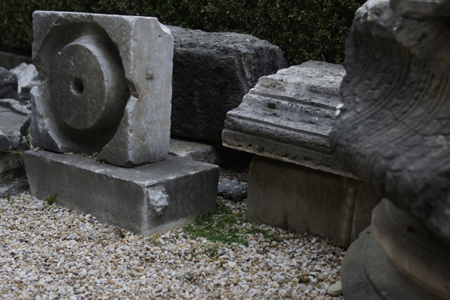
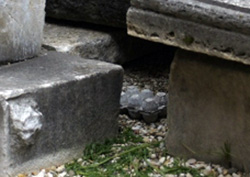
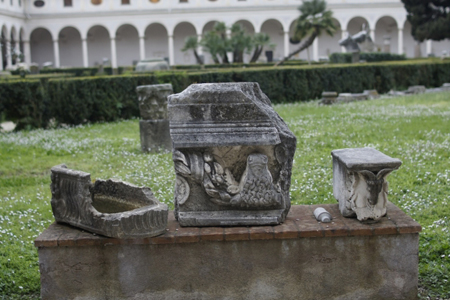
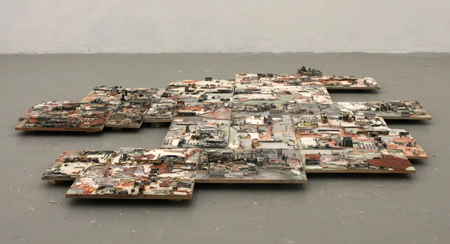
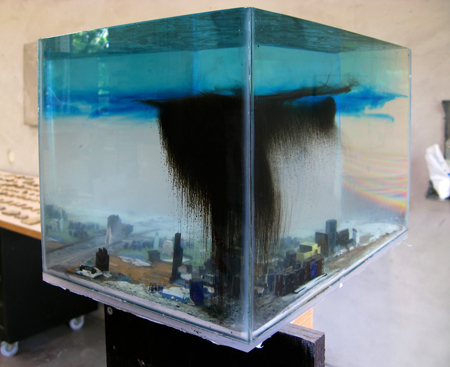
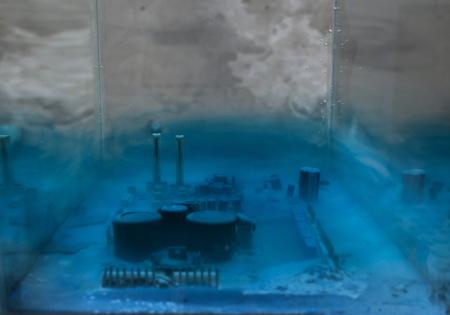
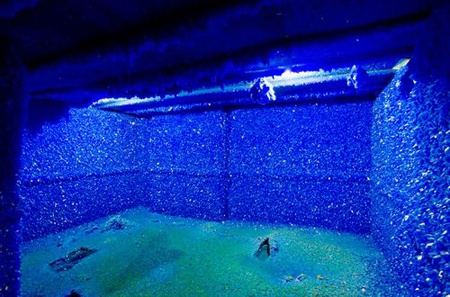
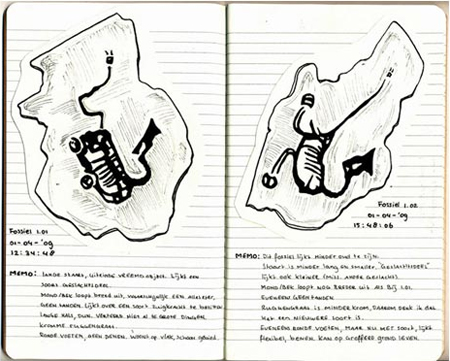
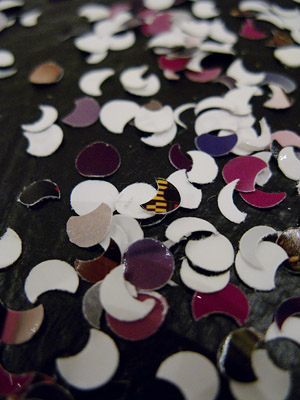
Caddisflies, aquatic insects of the order of Trichoptera are known all over the world. They are tiny nocturnal butterflies whose larvae feed on micro-organisms in non-polluted freshwater. In order to protect an extremely vulnerable abdomen, the larvae of a certain group constructs a portable case or tube consisting of mucus, bits of leaves, sand, etc. Mainly working in nightshifts it takes these one-centimeter-long little architects a week to complete their job. In natural surroundings the cases all look alike. This is not surprising as the material on hand differs very little. But what happens if the supply of stock is changed?

Felix van de beek

Felix van de beek

It presented no problem to the grubs. They used everything that was availeable, organic as well as inorganic: ironfilings, wood-chippings, beads, glass-splinters, bits of plastic and so on.

P.S. For the concerned animal lovers in the world: as for the larvae used in the project all flew happily out after the chrysalis stage

Based on a text by Pieter Beek

The Synthetic Kingdom

August 5th, 2010

Alexandra Daisy Ginsberg
A Natural History of the Synthetic Future, 2009

Synthetic Kingdom

The New Tree of Life 

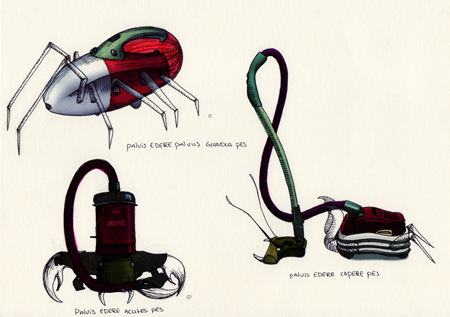
How will we classify what is natural or unnatural when life is built from scratch?  Synthetic Biology is turning to the living kingdoms for its materials library. No more petrochemicals: instead, pick a feature from an existing organism, locate its DNA code and insert it into a biological chassis. From DIY hacked bacteria to entirely artificial, corporate life-forms, engineered life will compute, produce energy, clean up pollution, make self-healing materials, kill pathogens and even do the housework. Manufacturers will transcend biomimicry, engineering bacteria to secrete keratin for sustainable vacuum cleaner casings; synthesise biodegradable gaskets from abalone shell proteins and fill photocopier toner cartridges with photosensitive E. coli.  Meanwhile, we’ll have to add an extra branch to the Tree of Life. The Synthetic Kingdom is part of our new nature.  Biotech promises us control over the natural world, but living machines need controlling. Biology doesn’t respect boundaries or patents. And in simplifying life to its molecular interactions, might we accidentally degrade our sense of self? Are promises of sustainability and unparalleled good health seductive enough to accept such compromise? - Alexandra Daisy Ginsberg

Synthetic Kingdom

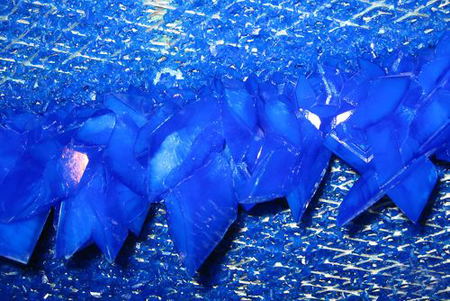
POLLUTION-SENSING LUNG TUMOR Terminal pathology from female smoker, 64 years of age. Analysis identified a novel species of silicon fabricator containing DNA from Japanese carbon monoxide detectors (manufacturer’s DNA tag intact). A double disease: her lungs grew carbon monoxide-sensing crystals in response to the presence of pollutants in her lungs.

Interactive Hunting Trophies

July 28th, 2010

France Cadet
Hunting Trophies, 2008

France Cadet Trophy

Cervus Elaphus Barbarus (North Africa Deer)

Hunting Trophies is a collection of 11 hunting trophies hung on the wall. They feature the most frequent species used in taxidermy for the realization of wall trophies, mainly deer and cat family. Instead of being real taxidermied animals they are chests of modified I-Cybie robots.  An infrared sensor allows the robots, each in its own way, to detect the presence but also the movements of visitors. As you approach, the robots turn their heads in your direction, their eyes light up, come too close and the robot suddenly growls. The closer you get, the more aggressive its behaviour.

France Cadet Trophy

France Cadet Trophy

The New World Order

April 11th, 2010

Bob de Graaf
On the Crossing of Species, 2010

bob de graaf

Limbs

1.  SPIDER’S LEG
2.  POLYCARBONATE PRICE HOLDER
3.  IRON HOOK
4.  BEND NAIL
5.  SCORPION’S LEG
6.  LIZARD’S LEG
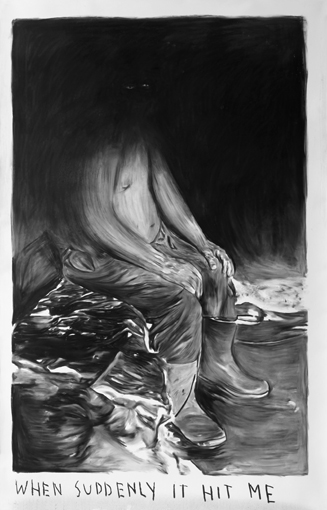
7.  GRASSHOPPER’S LEG
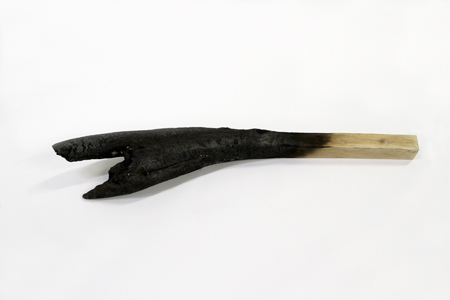
8.  SAFETY PIN
9.  PRAYING MANTIS FRONT LEG
10. FIREBUG’S LEG
11. FRAME HOLDER
12. LADYBUG’S LEG

13.
IRON HOOKNAIL

Bob de Graaf made a catalogue of different parts of animals and objects which he found in his surroundings.
‘My collection can be used to create a new order of species. By using the natural lifecycle of animals in everyday objects an evolutionary up-cycle can replace linear production systems. By breeding animal-like objects or object-like animals, we can construct a practical class of species.’

bob de graaf

Vanescrew (Synthia) Slotta, 2010

bob de graaf

Pieron (Artogeia) Napil, 2010

bob de graaf

GIY (Grow It Yourself)

March 19th, 2010

Alexandra Daisy Ginsberg (with Sascha Pohflepp)
Growth Assembly, 2009

Alexandra Daisy Ginsberg

Herbicide Sprayer (Nozzle Fruit)

Alexandra Daisy Ginsberg

Herbicide Gourd

Alexandra Daisy Ginsberg

Spike

Alexandra Daisy Ginsberg

Handle 

Alexandra Daisy Ginsberg

Connector

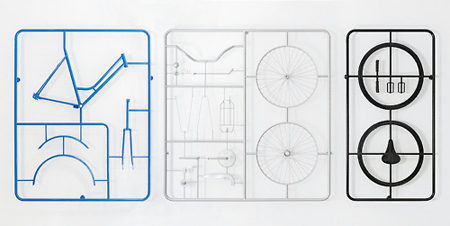
After the cost of energy had made global shipping of raw materials and packaged goods unimaginable, only the rich could afford traditional, mass-produced commodities.

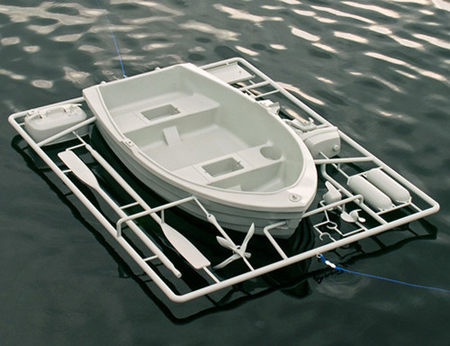
Synthetic biology enabled us to harness our natural environment for the production of things. Coded into the DNA of a plant, product parts grow within the supporting system of the plant’s structure. When fully developed, they are stripped like a walnut from its shell or corn from its husk, ready for assembly.

Shops have evolved into factory farms as licensed products are grown where sold. Large items take time to grow and are more expensive while small ones are more affordable. The postal service delivers lightweight seed-packets for domestic manufacturers.

Using biology for the production of consumer goods has reversed the idea of industrial standards, introducing diversity and softness into a realm that once was dominated by heavy manufacturing.

Alexandra Daisy Ginsberg

The product shown here is the Herbicide Sprayer, an essential commodity used to protect delicate engineered horticultural machines from older nature.

Plastic Reef

January 28th, 2010

From the 27th of January until the 12th of February 2010 I will be crossing the Atlantic Ocean on the Sea Dragon to look for plastic debris to feed the growing plastic reef below. Starting in Bermuda I will look for remnants of a society that still needs to disappear. You can follow the adventure on www.plasticreef.com

plastic reef

Stone-Aged

November 24th, 2009

John Roloff
Eocene,
1999-present
Paradise Ridge Sculpture Park, Santa Rosa, CA

John Roloff

‘Eocene, sited at the Paradise Ridge Sculpture Grove in Santa Rosa, CA, is a symbolic recreation of the climate of the Eocene geologic period of Northern California, which occurred from 40 to 60 million years go. Within a small region of moss covered rocks, live oak and laurel trees a moisture-laden microclimate has been created by a timed system of misting nozzles attached to the tree limbs emitting periodic rain showers on the area. The lushness of the misted area becomes more pronounced as the surrounding vegetation changes towards a golden brown during the summer months’.

Land Monitor/Fired Volcanic Boulder, 1980
Performance kiln/furnace, 20 ft. long, steel, ceramic fiber blanket, propane, earth, borax, lava boulder, near the J volcano outside Albuquerque, NM.

John Roloff

John Roloff

John Roloff

‘The steel and ceramic fiber blanket kiln was removed at the peak of the firing to expose the mafic (high iron/magnesium – low silica) basalt boulder, from the adjacent volcano, fired to a near-molten temperature, in an attempt for the viewer to physically re-experience the boulder’s birth/origin by returning it to a molten state. The cooled, altered, boulder and fused volcanic sand remained after the firing as a “land monitor,” of similar proportions to the monitor ships (ironclads) of the American Civil War’. - John Roloff -

Hallucigenia

November 7th, 2009

Martin Walde
AHIS, 2009

Martin Walde Hallucigenia

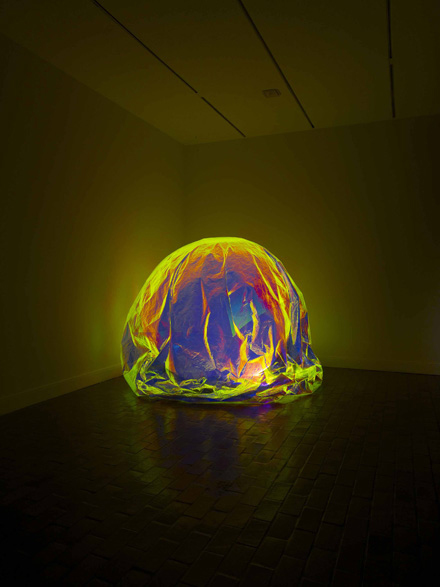
Thin walled glas bodies, filled with several different gases, are made to shine through high frequency technology. They are made to look like ancient small animals millions of years old which have been found in Kanada in 1977. S.C. Morris discovered these animals and called them “Hallucigenia”.

Chaotic Warfare

November 4th, 2009

Pascal Bernier
Hunting Accident - Deer, 1996

Pascal bernier

Hunting Accident - Tiger, 2000

Pascal bernier

Pascal Bernier
Butterfly, 1996-1998

‘According to theories on chaotic systems, the fluttering of a butterfly’s wing can eventually produce a hurricane.  Waging war against butterflies could perhaps become the ultimate weapon in the chaos strategy’.

Pascal bernier

Pascal bernier

Animal Anomalies

November 4th, 2009

Thomas Grünfeld
Misfit (Pig/Bird), 2001

Thomas Grunfeld

Misfit (St.Bernard/Sheep), 1994

Thomas Grunfeld

Thomas Grünfeld’s anomalous creations are some of the strangest and most surreal of contemporary taxidermy. The creatures from his appropriately titled Misfit series are composed of bits and pieces of animals, all flawlessly sewn together to create entirely new species. The Misfits are reminiscent of early natural histories in which strange and unfamiliar animals were described according to the bits and pieces of well known creatures. For example, the camelopard, now known as the giraffe, was described having the height and neck of a camel, the head of a stag although somewhat smaller, the teeth and feet of an ox, and a leopard’s spots. The armadillo was a pig with a turtle’s shell, and the sloth, part bear, part ape. The platypus displayed complete anatomical confusion, seeming to “possess a three fold nature, that of a fish, a bird, and a quadraped” as Thomas Bewick wrote in 1824. On inspecting the skin of a platypus for the first time in 1802, George Shaw, director of the British Museum, observed that it appeared to have “the beak of a Duck engrafted on the head of a quadruped.” Such a hybrid animal seemed too strange to be true, and Shaw claimed that “it is impossible not to entertain some doubts as to the genuine nature of the animal, and to surmise that there might have been some arts of deception in its structure.” In fact the specimen Shaw examined still bears the marks from his efforts to prise the beak off. As Shaw highlights, it is only a small step from describing animals as if they were composite to actually making a new species.

Thomas Grunfeld misfits Thomas Grunfeld misfits

Time’s Trial

September 2nd, 2009

Dieter Roelstraete 
Time’s Trial
On the Geological Imaginary in Contemporary Art

Sometime in the early nineties, the lights went out in modern and contemporary art museums around the world – some would say, paraphrasing Sir Edward Grey, the 1st Viscount Grey of Fallodon, not to be switched back on in our lifetime. This darkening of the countless white cubes of museums and galleries alike was meant to accommodate the entry of film into the hallowed space of art; although there had of course been film and video art before (think of Andy Warhol’s Empire or Sleep and Martha Rosler’s Semiotics of the Kitchen respectively), it was really artists like Eija-Liisa Ahtila, Matthew Barney, Stan Douglas, Douglas Gordon, Bill Viola and Gillian Wearing who ushered in the canonization of Hollywood-inflected film art (mostly conceived as spatial installations), and oversaw its subsequent transformation into what was probably the dominant, defining art form of the first half of the decade. Fifteen years on, it is worth remembering that quite a few of these artworks were in essence based on the simple tactic of slowing down, of deceleration; certainly some of the period’s most emblematic pieces (Douglas Gordon’s 24 Hour Psycho immediately comes to mind, but so do Viola’s films) revolved around the aesthetics of slow motion and the freeze (here we could cite Jeff Wall’s cinematic photographs as a programmatic example). There are many reasons why so many artists active at the very forefront of art’s habitual appropriation of cutting-edge technology (digital in this case) chose to slow down rather than – perhaps the more logical instinct, given that it had become technologically possible – speed up, but the advent of globalization as an everyday economic reality obviously played a major part in this, for the new world order of the electronic global village came with a new scopic regime in which the ceaseless acceleration, accumulation and proliferation of (digital) imagery gave new depth of meaning to the old situationist catchphrase of the “society of the spectacle”. Deceleration (and occasional paralysis) in moving-image-based art came to signal a critical stance not unlike that of the Luddites in early nineteenth-century, Industrial Revolution-era England, and pushing the pause button on the video camera (or in an early version of Final Cut Pro) could easily be constructed as symptomatic of a broader social or cultural demand for what the Dutch so poetically (hence untranslatably) call “onthaasting”: the conscious decision to lead a slower life of well-being.
In more recent times, art’s anxiety-ridden, traumatic relationship with the onslaught of time – always going forward, never going back; always going faster, never slowing down – has taken on a very different form, that of a “historiographic turn in art”: an obsession with the (recent) past and retrospective glance, excessive modulations of melancholy and nostalgia (the preferred tone of much ‘serious’ art produced in the last eight years or so), a compulsive desire for all that is anachronistic, archival and obsolete – all conspiring to produce that which Friedrich Nietzsche damningly called “the malady of history.” I have written elsewhere (and extensively so) about this chronomaniacal complex, focusing on one modality of the historiographic turn in contemporary art in particular – that of the archeological: artists collecting, digging, dusting off; revealing, uncovering, unveiling; excavating and lovingly inventorying the dumbstruck traces, shards and fragments of a distant, uncharted history (1).  An important factor in motivating this widespread artistic interest in archeology, as one particular form of historiography, concerns the paradigmatic character of the archeological enterprise as an episteme, i.e. as a truth procedure and site of the production of knowledge: archeology is (by its very definition, namely that of the scientific study of history’s material sources) bound to a materialist view of culture, history and society, and it is always also a science of origins – “archè” being the ancient Greek word for “beginning” or “first principle”. Dig and ye shall find – and seeing as the earth, and the many mute materials that it hesitatingly hands over to the industrious digger, cannot lie, the process of excavation ultimately functions as a promise of revelation, of the unveiling of a hidden truth. And ahistorical truth, of course, is the stable rock of comfort and assurance we’re after in these hectic, disorienting times of the ceaseless acceleration and proliferation of data (connective, visual and otherwise), the silent, stone-faced permanence of the ruin or the excavation site offering refuge from the teeming culture of speed that permeates our daily lives to such dizzying, and ultimately petrifying effect.

The rock, the ruin and all that is solid and made of stone: here we seamlessly slip into the adjacent realm of geology, where time is measured on a scale that makes even the archeological seem jittery with continuous shifts and changes – where the building, completion and subsequent erosion of the pyramids is not very different, as a ‘historical’ process, from subatomic motion: geology, as the scientific study of the earth’s crust and physical properties, has revealed that our miniscule heavenly body is not that much younger, relatively speaking, than the universe as a whole (4,5 billion years as opposed to the cosmos’ estimated 13,5 billion years). Geology as the realm of stasis then, of what seems, to the untrained human eye, absolute motionlessness – the imperious eternal Same: no wonder that geology has been an (admittedly strange) source of philosophical comfort in its own right, and has made occasional allegorical inroads into the world of art, especially since the so-called “chronophobic” Sixties, when artists first started to tap into the rich reservoir of the geological (as well as astronomical, biological, botanical, ecological) imagination (2).  Any consideration of the meeting of art and geology must of course pass by (or rather, depart from) Robert Smithson’s pioneering work in the Land or Earth Art movement, as well as his prolific activity as a critic and renegade art theorist. A lengthy quote from his widely-read essay “A Sedimentation of the Mind: Earth Projects” (1968) reminds us of Smithson’s keen awareness of art’s folding into an experience or philosophy of time that is aligned with the geological rather than the merely historical (or archeological): “The earth’s surface and the figments of the mind have a way of disintegrating into discrete regions of art. Various agents, both fictional and real, somehow trade places with each other – one cannot avoid muddy thinking when it comes to earth projects, or what I will call “abstract geology.” One’s mind and the earth are in a constant state of erosion, mental rivers wear away abstract banks, brain waves undermine cliffs of thought, ideas decompose into stones of unknowing, and conceptual crystallizations break apart into deposits of gritty reason. Vast moving faculties occur in this geological miasma, and they move in the most physical way. This movement seems motionless, yet it crushes the landscape of logic under glacial reveries. This slow flowage makes one conscious of the turbidity of thinking. Slump, debris slides, avalanches all take place within the cracking limits of the brain. The entire body is pulled into the cerebral sediment, where particles and fragments make themselves known as solid consciousness. A bleached and fractured world surrounds the artist. To organize this mess of corrosion into patterns, grids, and subdivisions is an aesthetic process that has hardly been touched (3).”  Smithson is best known today, of course, for his giant, megalomaniacal ‘interventions’ in the American natural landscape, most notably his Spiral Jetty (which, despite its monumental size, appears to be notoriously hard to find). Amid today’s incessantly expanding body of Smithson literature, the exegesis of Spiral Jetty in particular bears many markings of hagiographic hero worship (Matta-Clark is another favorite), yet there has been relatively little discussion of the relationship between geology and art’s epochal claim of “timelessness” (an important factor in all sainthood and sacrality): wasn’t Spiral Jetty geological – and no longer archeological, as was the case in the work of, say, Michael Heizer – in both scale and temporal conception because this best expressed the artist’s desire to move beyond time, to stand outside time’s merciless constraints – to ensure the kind of permanence and timelessness more commonly associated with the earth than with man’s cultivation of it? In the aforementioned essay, Smithson advises the artist to become the proprietor of art’s perceived timelessness, of the artwork as that which is a product of “no time at all”: “the deeper an artist sinks into the time stream the more it becomes oblivion; because of this, he must remain close to the temporal surfaces. Many would like to forget time altogether, because it conceals the “death principle.” Floating in this temporal river are the remnants of art history, yet the “present” cannot support the cultures of Europe, or even the archaic or primitive civilizations; it must instead explore the pre- and post-historic mind; it must go into the places where remote futures meet remote pasts (4)”  – into the spaces of geological time, such as lifeless deserts (in his exemplary case) untouched by man’s corrupting presence. For deserts, as the domains of death (or at least of a deep-seated hostility towards life), are zones “out of time” par excellence, their forbidding, morbid silence the wind-swept ‘proof’ of the alignment of geology with the a- or anti-historical – this timelessness the dream, precisely, of many a land art project.

As one may have gathered from these few sentences, I am no great lover of the desert, of which it is said somewhere, in Tuareg wisdom, that silence is its prayer – indeed, could the great nay-saying Monotheistic religions ever have emerged anywhere else? It is no coincidence that one of the worst touristic experiences of my life [details omitted] happened on the very edge of the Sahara, south of the Moroccan city of Zagora. That said, however, one of the finest artistic experiences of my life, in a strictly touristic sense, also involved a trip to desert – this one under the knowing guidance, it should be added, of the Los Angeles-based ‘artist’ collective Center for Land Use Interpretation, who organize bus trips into the Mojave desert, including such memorable highlights as a visit to the mining town of Boron (home to the largest borax mine in the world) and the ultra-atmospheric Mojave airplane boneyard along the California State Route 14. Perhaps this was such a memorable experience precisely because the Center for Land Use Interpretation, as a bunch of time bandits, pull off that which so many others like (and unlike) them do not (mainly because of the programmatic immodesty and ultimate humorlessness of the latter’s many attempts), and this clearly has something to do with the risky business of trying to marry art and science (geology in this case), art and information, art and pedagogy – and entertainingly, parodically so to boot. But the success of their venture (and relatively high profile in a contemporary art world that is justifiably averse to positivist, lab coat-clad posing) is ultimately also linked to the object of their loving, slightly mocking faux-geological scrutiny: the city of Los Angeles and its built-up surrounds, a city whose short history was chronicled by Mike Davis in a book that promised to “excavate the future of L.A.” Can a future be excavated at all? Can the geological clock be wound (fast) forward, and art dream about tomorrow for a change? Exactly because of Los Angeles’ perceived lack of (natural) history – another prominent chronicler of L.A. culture and lore, Norman Klein, dubbed it the capital of forgetting (5)  – and both its relative youth as well as its cultural obsession with youth, its historiography must be conducted in a spirit of slight irreverence, and there is perhaps no better way to do so than by reconstructing this history as a geological field trip along a string of imaginary excavation sites (such as a mining town): the geological fixation of many art practices, after all, always serves to signal art’s unease – in this case endemic to Angeleno culture – with the ruthlessness of the passage of time. And much more to the point of the present (that is to say, Maarten Vanden Eynde’s) curatorial undertaking, CLUI’s geo-archeological field trips do not concern natural wonders (the conventional destinations of such specialized tourism), but rather those naturalized ‘wonders’ left behind, in the haste typical of the Gold Rush’ provisional living, by man: theirs is not a geology of the natural, but one of the cultural world, proving that the daily practice of history (i.e. archeology) is a “quintessential tool for denaturalizing the social” indeed (6).  A geology, not so much of the earth, then, but of the patterns of scars laboriously carved into its surface, rendered legible as a document of man’s restless passing across even the world’s remotest expanses.
A geo-logy of the cultural world rather than the earth upon which it rests: a paradox this may seem perhaps, but isn’t ‘paradox’ the very logic of all art?


(1) See, among others, my “The Way of The Shovel: On the Archeological Imaginary in Contemporary Art,” published in e-flux journal #4, March 2009 (to which the subtitle of the present essay refers); “After the Historiographic Turn: Current Findings,” published in e-flux journal #5, May 2009; “Whose ‘End of History’?”, published in Yilmaz Dziewior (ed.), Jahresring 56: Wessen Geschichte? Whose History?, Berlin: Kulturstiftung des Bundes & Köln: Verlag der Buchhandlung Walther König, 2009 (forthcoming); and “Listen to the Stones: Mariana Castillo Deball Among the Ruins”, published in Mousse Magazine #21, September 2009.
(2) The reference here is to Pamela M. Lee’s book-length study Chronophobia: On Time in the Art of the 1960s. In it, Lee links 1960s art’s anxious examination of the issue of time (history, progress, speed) to the “emergence of the Information Age in postwar culture. The accompanying rapid technological transformations, including the advent of computers and automation processes, produced for many an acute sense of historical unknowing; the seemingly accelerated pace of life began to outstrip any attempts to make sense of the present. Lee sees the attitude of 1960s art to time as a historical prelude to our current fixation on time and speed within digital culture.” [From the MIT Press website, ed.]
(3) Quoted in: Robert Smithson, Collected Writings, Berkeley, University of California Press, 1996, p. 100.
(4) Ibid., p. 112.
(5) Norman Klein, The History of Forgetting: Los Angeles and the Erasure of Memory, London & New York: Verso, 2008.
(6) “History represents the quintessential tool for denaturalizing the social; as a result, it goes hand in hand with critique,” in: Luc Boltanski & Eve Chiapello, The New Spirit of Capitalism, London & New York: Verso, 2003, p. 8.

The River Is Always Greener On The Other Side

August 29th, 2009

Olafur Eliasson
Green River, Stockholm, Sweden, 2000

Olafur Eliasson

Green River, Moss, Norway, 1998

Olafur Eliasson

‘One Friday at half past one there I was on the bridge with Emile and a bag full of red powder and people starting to stare at us. I hesitated for a moment then emptied the bag out over the parapet and the wind whipped up this enormous red cloud. I could literally feel people in cars slowing down, the cars went all quiet. And there was this cloud, floating over the river like a layer of gas. When it came in contact with the water, all of a sudden the river turned green, it was like a shock wave. There was a crowded bus ten metres a way and everybody was staring at the water. I told Emile we should maybe move on, as if everything was perfectly normal, then I carefully put the bag in a trashcan, as if colouring the centre of Stockholm was the kind of thing I did every day. I went down to IASPIS and when I came out again my heart started jumping up and down like mad: the whole length of the river was completely green and all these people had stopped to look at it. Next day it was all over the front page of the papers: “The river turned green”. The colorant was absolutely harmless and there was no pollution whatsoever’.

Abstract of a conversation between Hans Ulrich Obrist and Olafur Eliasson, 2002

Inland Islands

August 29th, 2009

Christo and Jeanne-Claude
Surrounded Islands, Biscayne Bay, Greater Miami, Florida, 1980-83

Christo

On May 7, 1983 the installation of Surrounded Islands was completed. In Biscayne Bay, between the city of Miami, North Miami, the Village of Miami Shores and Miami Beach, 11 of the islands situated in the area of Bakers Haulover Cut, Broad Causeway, 79th Street Causeway, Julia Tuttle Causeway, and Venetian Causeway were surrounded with 585,000 square meters (6.5 million square feet) of pink woven polypropylene fabric covering the surface of the water, floating and extending out 61 meters (200 feet) from each island into the Bay. The fabric was sewn into 79 patterns to follow the contours of the 11 islands.

For 2 weeks Surrounded Islands spreading over 11.3 kilometers (7 miles) was seen, approached and enjoyed by the public, from the causeways, the land, the water and the air. The luminous pink color of the shiny fabric was in harmony with the tropical vegetation of the uninhabited verdant island, the light of the Miami sky and the colors of the shallow waters of Biscayne Bay.

Christo

Photo: Wolfgang Volz ©1983 Christo
The World Dubai

The World is a man-made archipelago of 300 islands constructed in the rough shape of a map of the landmasses of the Earth, located 4 kilometres off the coast of Dubai, United Arab Emirates.

The Walk of Fame

August 29th, 2009

Richard Long
Circle in the Andes
, 1972

Richard Long

‘Nature has always been a subject of art, from the first cave paintings to twentieth-century landscape photography. I wanted to use the landscape as an artist in new ways. First I started making work outside using natural materials like grass and water, and this led to the idea of making a sculpture by walking. This was a straight line in a grass field, which was also my own path, going ‘nowhere’. I like the idea of making something from nothing. In the mid-sixties I began to think that the language and ambition of art was too formal and orthodox. I felt it had barely engaged with the natural landscapes which cover our planet, or used the experiences those places could offer. Starting from my home territory and gradually spreading further afield, my work has tried to explore this potential. I see it as abstract art laid down in the real spaces of the world. It is not romantic; I use the world as I find it’. - Richard Long -

Dusty Boots Line Sahara, 1988

Richard Long

Michael Heizer
Double Negative, 1969-70

Michael Heizer

Double Negative is Michael Heizer’s first prominent earthwork. Double Negative consists of two trenches cut into the eastern edge of the Mormon Mesa, northwest of Overton, Nevada in 1969-70. The trenches line up across a large gap formed by the natural shape of the mesa edge. Including this open area across the gap, the trenches together measure 1,500 feet long, 50 feet deep, and 30 feet wide (457 meters long, 15.2 meters deep, 9.1 meters wide). 240,000 tons (218,000 tonnes) of rock, mostly rhyolite and sandstone, was displaced in the construction of the trenches.

Industrial Gardening

August 28th, 2009

Panamarenko
Hofkes, 1967

Panamarenko Hofkens

Three thick sheets of cardboard of about 1m2 are filled with a variety of inorganic trash and debris. From a prophetic kind of future vision Panamarenko nostalgically tries to restore and reconstruct the long lost city-gardens. These city-gardens functioned as urban alternative for life on the countryside and provided additional food for the unfortunate. By the steady increase of city residents (in 2008 a remarkable event took place: the majority of the world population lives now in a city) the necessity to have physical contact with the earth and live from the land is gone. People are used to this new, self-created landscape and recognize the urban environment as their natural habitat.